
Is It Really Sciatica?
If you’ve ever experienced pain that starts in your low back and shoots down your leg, chances are you’ve heard someone say,
“That’s sciatica.”
We hear it almost every day at Premier Chiropractic Clinic.
“My coworker said it was sciatica.”
“My MRI showed a bulging disc.”
“I think I pinched a nerve.”
Sometimes those statements are accurate.
Sometimes they’re close.
Sometimes they’re pointing us in the wrong direction entirely.
One of the biggest misconceptions surrounding leg pain is that every pain traveling below the knee is “sciatica.”
While sciatica is certainly common, it isn’t actually a diagnosis. It’s a description of symptoms.
The real question is why that nerve is irritated.
That’s where lumbar radiculopathy enters the conversation.
The distinction may sound like medical jargon, but understanding it can make a tremendous difference in choosing the right treatment.
At Premier Chiropractic Clinic, our goal isn’t simply to label your condition. It’s to understand what’s driving your symptoms so we can build a treatment plan around the root cause—not just the pain.
Understanding the Sciatic Nerve
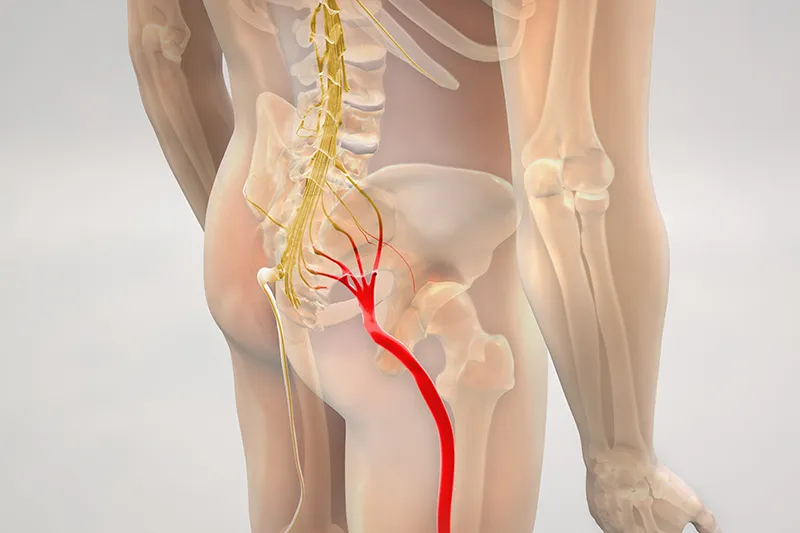
The sciatic nerve is the largest nerve in the human body.
It begins in your lower spine, where several individual nerve roots (L4, L5, S1, S2, S3) leave the spinal cord. Those nerve roots join together in the pelvis before forming the large sciatic nerve that travels through your buttock, down the back of your thigh, branches around your knee, and continues into your lower leg and foot.
Because the nerve travels such a long distance, irritation almost anywhere along that pathway can produce symptoms that seem surprisingly widespread.
Patients commonly describe:
- Burning pain down the leg
- Sharp “electric” sensations
- Tingling or pins and needles
- Numbness in the calf or foot
- Weakness climbing stairs
- Pain that worsens after sitting
- Difficulty finding a comfortable sleeping position
Some patients only notice discomfort while driving.
Others cannot sit through dinner without constantly shifting positions.
The important point is this:
Sciatica describes where the symptoms travel—not necessarily what’s causing them.
So What Is Lumbar Radiculopathy?
Lumbar radiculopathy is more specific.
Rather than describing the symptoms, it describes where the problem begins.
The word breaks down surprisingly well.
- Lumbar = lower back
- Radicul = nerve root
- -opathy = irritation or disorder
Instead of saying “your sciatic nerve hurts,” lumbar radiculopathy tells us that one of the nerve roots leaving your lower back is irritated before it ever joins the sciatic nerve.
Think of several neighborhood roads merging onto one interstate.
If traffic backs up before the merge, every driver downstream feels the effects.
Your nervous system works much the same way.
For example, an irritated L5 or S1 nerve root can produce pain that travels all the way into your foot because that nerve root eventually becomes part of the sciatic nerve.
What Causes Lumbar Radiculopathy?
There isn’t one single cause, which is why a careful evaluation matters.
Some of the most common contributors include:
Disc Herniation
Between each vertebra sits an intervertebral disc.
These discs act as shock absorbers while allowing the spine to move.
If part of the disc bulges or herniates, it may irritate a nearby nerve root.
It’s important to know that disc bulges are surprisingly common, even in people who have no pain whatsoever. Research has shown that many healthy adults have disc bulges on MRI without ever developing symptoms.
That’s why imaging findings must always be interpreted alongside a physical examination.
Degenerative Changes
As we age, our joints naturally change.
Arthritic changes, bone spurs, and decreased disc height can gradually narrow the spaces where nerves exit the spine.
This narrowing—called foraminal stenosis—doesn’t always cause pain, but in some people it contributes to nerve irritation.
Inflammation
Sometimes a nerve isn’t significantly compressed at all.
Instead, inflammatory chemicals released by injured tissues make the nerve hypersensitive.
Think about getting lemon juice in a paper cut.
Nothing is squeezing the cut, but it certainly hurts.
Inflammation around a nerve can create a similar phenomenon, making movements that were previously painless suddenly become very uncomfortable.
This is one reason why our treatment plans often address both mechanics and inflammation through lifestyle changes and strategic supplements from another Pittsburgh Company Called Nutritional Frontiers.
Movement Dysfunction
This is one of the most overlooked causes of recurring back and leg pain.
Your spine doesn’t work in isolation.
Every step you take begins with your feet.
Force travels from your feet through your ankles, knees, hips, pelvis, and finally into your lumbar spine.
If one link in that kinetic chain isn’t functioning efficiently, another area often compensates.
We’ve seen patients whose recurring “sciatica” improved after addressing limited hip mobility.
Others benefited from improving ankle mechanics.
Some needed custom Foot Levelers® orthotics because poor foot mechanics were altering how forces traveled up the chain with every step.

Pain often appears where the body compensates—not where the problem actually began.
That’s why we evaluate the entire kinetic chain instead of focusing solely on the painful area.
Why Imaging Isn’t Always the First Step
One of the biggest surprises for many new patients is that we don’t immediately recommend an MRI.
That doesn’t mean imaging isn’t valuable.
It absolutely has its place.
But imaging should answer a clinical question—not replace one.
A thorough history and physical examination often provides an incredible amount of information before advanced imaging is ever considered.
During your examination we evaluate:
- Muscle strength
- Deep tendon reflexes
- Sensation
- Walking mechanics
- Hip mobility
- Pelvic motion
- Lumbar movement
- Orthopedic testing
- Neurological findings
We’re looking for patterns.
Does bending forward reproduce symptoms?
Does walking relieve them?
Does coughing increase pain?
Is the weakness following a particular nerve root?
The answers to those questions frequently tell us far more than imaging alone.
An MRI shows anatomy.
A physical examination shows function.
Both matter but they answer different questions.
Common Myths About Sciatica
Myth #1: “If the pain goes into my leg, I must have a slipped disc.”
Not necessarily.
Muscles, joints, ligaments, and even hip conditions can refer pain into the leg.
That’s why guessing based on symptoms alone is difficult.
Myth #2: “I should stay in bed until it feels better.”
Years ago this was common advice.
Today we know that prolonged rest often slows recovery.
Gentle movement, when appropriate, typically helps maintain circulation, reduce stiffness, and keep the nervous system active.
The goal isn’t to push through severe pain—it’s to avoid becoming fearful of movement altogether.
Myth #3: “If I have nerve pain, surgery is inevitable.”
Fortunately, that’s rarely true.
Many cases of lumbar radiculopathy improve with conservative care.
Surgery is absolutely appropriate for certain patients, particularly when there is progressive weakness, significant neurological loss, or bowel and bladder changes.
But many people recover without ever needing an operation.
One of our goals is helping patients understand where they fall along that spectrum.
Our Whole-Body Approach at Premier Chiropractic Clinic
Every patient who walks into our office has a unique story.
Some have just injured their back lifting mulch.
Others have struggled with recurring sciatica for years.
Some have already tried injections, medication, or physical therapy.
Rather than applying the same treatment to everyone, we begin with a comprehensive examination designed to identify the factors contributing to your pain.
Depending on your findings, your treatment plan may include chiropractic adjustments to restore healthy joint motion in the spine, pelvis, hips, or even the feet and ankles. Many people are surprised to learn that chiropractors don’t just adjust the spine. Healthy movement throughout the entire kinetic chain often plays an important role in reducing stress on irritated nerves.
For patients with disc-related symptoms, Back on Trac spinal decompression may be recommended to help reduce mechanical stress through the lumbar spine. Others may benefit from Shockwave Therapy if chronic soft tissue dysfunction is contributing to their symptoms.
Exercise is another key piece of the puzzle.
Rather than handing every patient the same list of stretches, we prescribe exercises based on what your examination tells us. Sometimes that’s improving hip mobility. Sometimes it’s strengthening the glutes. Sometimes it’s teaching diaphragmatic breathing to improve intra-abdominal pressure, core stability, and nervous system regulation.
We also recognize that healing doesn’t happen in a vacuum.
Nutrition, sleep quality, stress management, and inflammation all influence recovery. When appropriate, we may recommend nutritional strategies or targeted supplementation to support tissue healing as part of a comprehensive treatment plan.
Our philosophy is simple:
Treat the person—not just the painful body part.
What Can You Do Today?
If you’re experiencing pain traveling down your leg, don’t panic—but don’t ignore it either.
There are several simple steps that can help while you’re waiting to be evaluated:
- Stay gently active if your symptoms allow.
- Avoid prolonged bed rest.
- Change positions frequently instead of sitting for long periods.
- Pay attention to movements that consistently improve or worsen your symptoms.
- Practice diaphragmatic breathing to reduce unnecessary muscle tension and improve core stability.
- Seek a professional evaluation if symptoms persist, worsen, or are accompanied by weakness or numbness.
Most importantly, resist the urge to self-diagnose based on internet searches alone. Two people with nearly identical symptoms may require completely different treatment plans depending on what’s actually causing the nerve irritation.
The Bottom Line
Leg pain can be frustrating, confusing, and sometimes frightening.
The good news is that many causes of sciatica and lumbar radiculopathy respond well to conservative care when they’re properly evaluated.
At Premier Chiropractic Clinic, we believe the first step isn’t guessing.
It’s listening.
By combining a detailed history, comprehensive physical examination, and whole-body approach to movement, we work to identify the true source of your symptoms and create a treatment plan designed specifically for you.
Whether your pain started yesterday or has been lingering for years, understanding why it’s happening is often the first step toward feeling better.
If you’re tired of chasing symptoms and ready to find the underlying cause, we’d love to help. Schedule an appointment with Premier Chiropractic Clinic today, and let our team guide you toward moving with greater confidence, less pain, and a clearer understanding of your body.
Related:
- Why Does My Back Hurt?
- Back Pain Relief: Common Causes, Stretching, Morning Stiffness & 5 Myths Explained
- How Your Feet Can Affect Your Low Back (Coming Soon)
- Back on Trac Spinal Decompression: Is It Right for You? (Coming Soon)
- Is Heat or Ice Better for Pain? (Coming Soon)

Ready to Find Out What’s Really Causing Your Leg Pain?
If leg pain keeps slowing you down—or you’ve been told it’s sciatica without a clear explanation of why—we’re here to help.
Schedule a comprehensive evaluation with one of our doctors. We’ll take a detailed history, perform a thorough examination, and explain our findings in plain language so you understand what’s driving your symptoms.
Call Premier Chiropractic Clinic today or schedule your appointment online. Let’s find the real cause of your leg pain and get you moving with confidence again.